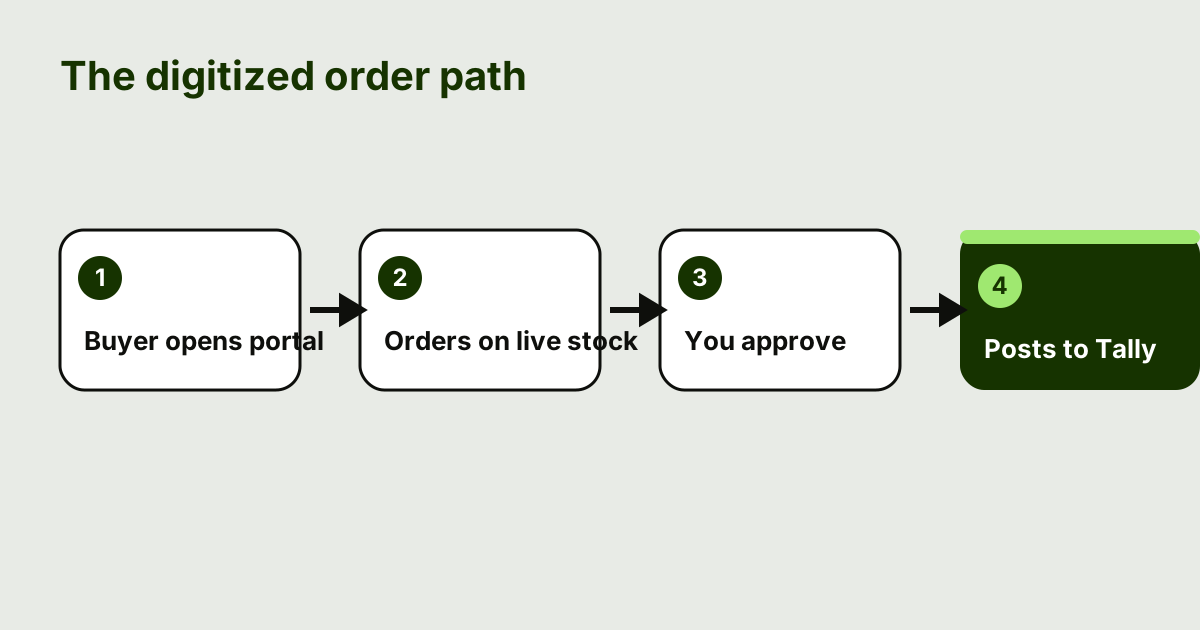
Digitizing distribution ordering means letting your buyers place their own orders against live stock and their own price, then syncing every approved order straight into Tally. You do not need to replace Tally or buy a full ERP to do it. This guide walks the whole path: what it means, what it fixes, the exact steps, and the smallest thing you can change this week.
What does digitizing distribution ordering actually mean?
It means replacing manual order intake and manual data entry. Today an order arrives as a phone call, a WhatsApp message, or a photo of a handwritten list. Someone reads it, checks stock in their head or in a spreadsheet, confirms a price, and then types the whole thing into Tally. Digitizing that flow moves the order into a structured system once, at the source, so nobody re-keys it later.
It is worth being clear about what this is not. It is not a full ERP rollout. It is not a distribution management system built for large FMCG field teams. It is not a CRM for chasing buyers. It is one focused change: your buyers order themselves against live stock and their tier price, you approve, and the approved order lands in Tally as a delivery challan.

What does the phone, WhatsApp and spreadsheet stack really cost you?
The manual stack looks free because no one sends you an invoice for it. The cost shows up somewhere else: in re-keyed orders, in stock that never matches the system, in the wrong price going to the wrong buyer, and in your team spending the morning transcribing WhatsApp instead of selling. It usually breaks in four predictable ways. Each one has a dedicated guide below.
Inventory you cannot trust
When orders are taken by hand and entered into Tally hours later, the stock number you quote from is always a little stale. Counts drift across godowns, short-shipments go unrecorded, and a distributor with a few thousand SKUs quietly carries real variance. You end up ordering and promising against a guess.
Overbooking on every spike
On a busy day you sell from that stale number, and two buyers get promised the same stock. Someone gets let down after the fact. This is not carelessness. It is structural: the available number was old before the order was even taken. For the deeper fix, see the guide on how to stop overselling stock.
Price mismatches
Every buyer is on a different rate, and the rates live in a spreadsheet or an old PDF sent on WhatsApp. A salesperson quotes last month's price, or the wrong tier, and now you either eat the margin or argue with the buyer. Wrong-price disputes are one of the most expensive mistakes in wholesale.
Orders trapped in chat
The order exists only inside a WhatsApp thread until a human copies it out. There is no audit trail, no clean record, and the same order gets entered twice: once in chat, once in Tally. The guide on Tally order automation covers how to break that double-entry loop.
What does a distributor ordering portal do?
A distributor ordering portal is a private catalogue your buyers log into. Instead of messaging you, they build their own order and submit it. You review and approve. It handles the four cracks above directly:
- Self-serve ordering, around the clock. Buyers browse a clean catalogue or paste a SKU list, and every line shows a live stock badge.
- Tier and brand pricing, with masking. Each buyer sees only their brands at their own rate, so no one is quoted the wrong price.
- An approval workflow. Orders queue for you to review, adjust, approve or reject, with a full audit trail. You keep control.
- Real-time inventory. Available stock is on-hand minus what is already reserved, and approving an order reserves it automatically.
- Live Tally sync. An approved order posts a delivery challan into Tally, moves stock, and can raise a GST invoice. It also works with Zoho and Odoo.
The reorder assistant and instant order or price answers that AI will add are a later roadmap layer, switched on once the portal is live. The portal earns its keep on the mechanics above first.

How do you digitize ordering, step by step?
You do not have to do this all at once. Run it in order, and you can go live with one brand and a handful of buyers before you roll it out to everyone.
- Clean the catalogue. Get your SKUs, pack sizes and units consistent. This is the single biggest determinant of how smooth the rest goes, because everything downstream maps to these codes.
- Set buyer tiers and visibility. Decide who sees which brands and at what rate. This is where price masking replaces the scattered PDFs.
- Decide the approval flow. Choose what auto-approves and what needs a human look (a new buyer, an unusually large order, a credit hold).
- Connect Tally. Map your ledgers, tax and party masters so an approved order posts cleanly as a challan. Get this right on one product line first.
- Onboard your buyers. Invite your most active buyers first. They feel the benefit fastest and become the proof for the rest.
- Keep WhatsApp as the doorway. You do not have to ban WhatsApp. Point buyers to the portal link from the same chat they already use, so the order is captured once instead of transcribed.
Do you keep Tally and stay in control?
Yes on both. The portal sits on top of the Tally you already run. Nothing posts to Tally until you approve it, so the owner keeps the same control they have today. The difference is that approval is a click instead of a re-typing job, and the challan and stock movement happen automatically once you approve.
A multi-brand fragrance and cosmetics distributor we worked with ran every order by phone and re-keyed it into Tally. After moving to a portal, order handling went from about 30 minutes to about 2 minutes per order, mis-keyed orders went from roughly 100 a month to zero, more than 3,000 SKUs went live, and each approved order produced an automatic delivery challan and GST invoice. The owner did not give up control. They gave up the typing.
Do you need an ERP or a DMS for this?
Usually not. A full ERP or a distribution management system solves a much broader problem than order intake, and it asks you to change how your whole business runs. If your actual pain is that orders come in by chat and get re-keyed into Tally, an ordering portal on top of Tally is the lighter, faster fix. For a criteria-by-criteria comparison, see the guide on choosing distributor ordering software, which lays out honestly when a full ERP or DMS is the right call and when it is overkill.
What should you do this week?
Do not try to boil the ocean. Pick one thing and make it real:
- Choose one brand or product line and one price tier.
- Get that catalogue and its prices clean and correct.
- Put one active, friendly buyer on a self-serve order for that line and route the result into Tally.
- Watch how long it takes end to end, and how many keystrokes you saved.
That single loop tells you more than any demo. Once one buyer orders themselves against live stock and the order lands in Tally without re-typing, the path to doing it for everyone is just repetition.
If you want to see this on your own catalogue and your own Tally setup, book a call and we will map your first line together.