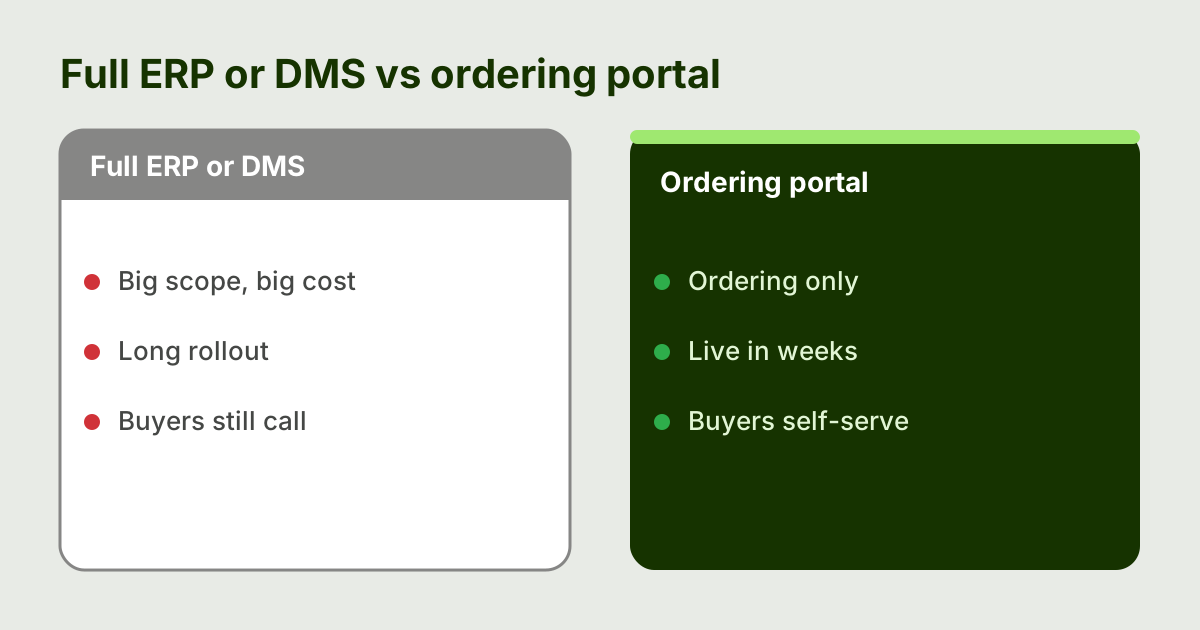
The best distributor ordering software lets your buyers place their own orders against live stock and their own price, then syncs approved orders into Tally. Most distributors in India do not need a full ERP or a distribution management system to get there. This is an honest buyer's guide: the criteria that matter, the options compared, and how to run a trial that actually tells you something.
What should distributor ordering software do?
Strip away the feature lists and there are five non-negotiables. If a tool does not do these, it is not solving the distributor ordering problem, whatever else it does.
- Self-serve ordering: your buyers build and submit their own orders, instead of messaging your team.
- Live stock at order time: every line shows what is actually available, so buyers are not promised stock you do not have.
- Tier and brand pricing with masking: each buyer sees only their brands at their own rate.
- An approval workflow with an audit trail: you review, adjust and approve, and every order is on record.
- ERP sync: approved orders post into Tally, Zoho or Odoo as a challan and move stock, without re-keying.

Which criteria actually matter when you compare tools?
Every vendor demo looks good. These are the questions that separate tools once real orders start flowing.
Buyer usability
Your buyers are busy shop owners and purchase managers, not software users. If the portal is hard to use on a phone, they will fall back to WhatsApp and you are back where you started. Usability for the buyer is the single biggest predictor of adoption.
The India-specific checks
Most software that ranks for these searches is built for the United States or Europe and never mentions the tools you actually run. Check the things that matter here: does it sync with Tally, does it produce a correct GST invoice and delivery challan, and does it fit the way your buyers already order on WhatsApp.
Pricing control
You need per-buyer or per-tier pricing, brand visibility, and the ability to change a rate in one place without emailing a new PDF to everyone. Wrong-price disputes are one of the most expensive mistakes in wholesale, so this is not a nice-to-have.
Approval and audit
You should be able to review orders before they commit stock, set what auto-approves, and see a full history. This is how you keep control while removing the manual work.
Onboarding effort and price
Ask how long it takes to get one brand and a few buyers live, not the whole business. A tool you can prove on one product line in weeks beats a platform that needs a six-month rollout before anyone places an order.
What are your options, honestly compared?
There are four broad choices. Each solves a real problem, but they are not interchangeable.
A full ERP
An ERP runs your whole business: finance, purchasing, inventory, and more. It is powerful and it is heavy. If your main pain is that orders come in by chat and get re-keyed into Tally, an ERP is far more than you need, and it asks you to change how everything runs.
A distribution management system or SFA
Distribution management systems are usually built for large FMCG brands managing field sales teams, schemes and route-to-market. If you are a multi-brand distributor whose buyers order from you directly, most of that machinery does not apply to you.
Generic B2B ecommerce
A general B2B store can take orders, but it often assumes a cloud-native setup and rarely speaks Tally, GST or tier pricing the way an Indian distributor needs. You can end up bending your business to the tool.
A distributor ordering portal
A portal does one thing well: buyers self-serve orders against live stock and their own price, and approved orders sync to Tally. It is the lightest fit when order intake is the actual problem, and it sits on top of the Tally you already run rather than replacing it. For the full picture of that shift, see the pillar guide on how to digitize distribution ordering.
When do you actually need an ERP or a DMS?
Be honest with yourself here. You lean toward a full ERP or DMS when you need deep manufacturing, complex multi-entity finance, or a large field-sales operation with schemes and claims to manage. You lean toward an ordering portal when your pain is squarely about taking orders and getting them into Tally cleanly. Many distributors discover the portal fixes the pain they actually have, and they keep Tally for the books.
How do you run a trial that tells you something?
Do not judge on a demo. Judge on one real loop.
- Pick one brand or product line and get its catalogue and prices clean.
- Put two or three of your most active buyers on the portal for that line.
- Run it for a week and route the approved orders into Tally.
- Measure the things that matter: did buyers actually use it, how long did each order take end to end, and how many orders got re-keyed by hand (the answer should be zero).
A multi-brand fragrance and cosmetics distributor we worked with ran exactly this kind of change and saw order handling drop from about 30 minutes to about 2 minutes per order, with mis-keyed orders going from roughly 100 a month to zero across more than 3,000 SKUs. Your numbers will differ, but the test is the same: one line, a few buyers, one week.
If you want help scoping that trial on your own catalogue and Tally setup, book a call. For the mechanics of the Tally side specifically, see the guide on Tally order automation.